Agency Guide · Updated April 2026
Best AEO Tools for Marketing Agencies in 2026:
Ranked for multi-client teams.
Published April 21, 2026 · Updated April 21, 2026
Agency AEO economics break differently than in-house brand economics. Your unit of work is the client, not the brand. Your unit of profit is retention, not conversion. Your platform decision is a per-seat, per-client, per-deliverable calculation that has to survive a 12-month book. The platforms below are ranked by how they hold up across a real agency P&L and how their deliverables compare when a client asks what they're paying for.
What an AI visibility platform needs to do for a multi-client agency
Agency AEO demands six disciplines that a single-brand user can mostly skip:
- Multi-tenant access and permissions. Your account manager should see all clients. Your junior strategist should see only their four. Your clients should see only themselves. Flat-access platforms create compliance headaches on day one.
- Per-client economics that don't break your margin. If platform cost exceeds 8% of retainer, the math doesn't work once you add execution hours.
- White-label or co-branded client reports. Clients expect branded deliverables. Routing them back to a vendor logo undercuts your positioning.
- New-business instruments. A free audit you can run on a prospect is a pitch asset. Platforms without a prospect-facing entry point force you to build one from scratch.
- Client-facing deliverables that bill. A dashboard is table stakes. A quarterly topical map or strategy brief is what clients retain for.
- Vertical flexibility. DTC, SaaS, and local-service clients need different axes. A platform that treats them identically forces you to hack around it.
Every platform below does the first two disciplines at some level. White-label and client-facing branding is where mid-tier and enterprise separate. New-business instruments and vertical flexibility are where only a couple of platforms currently deliver.
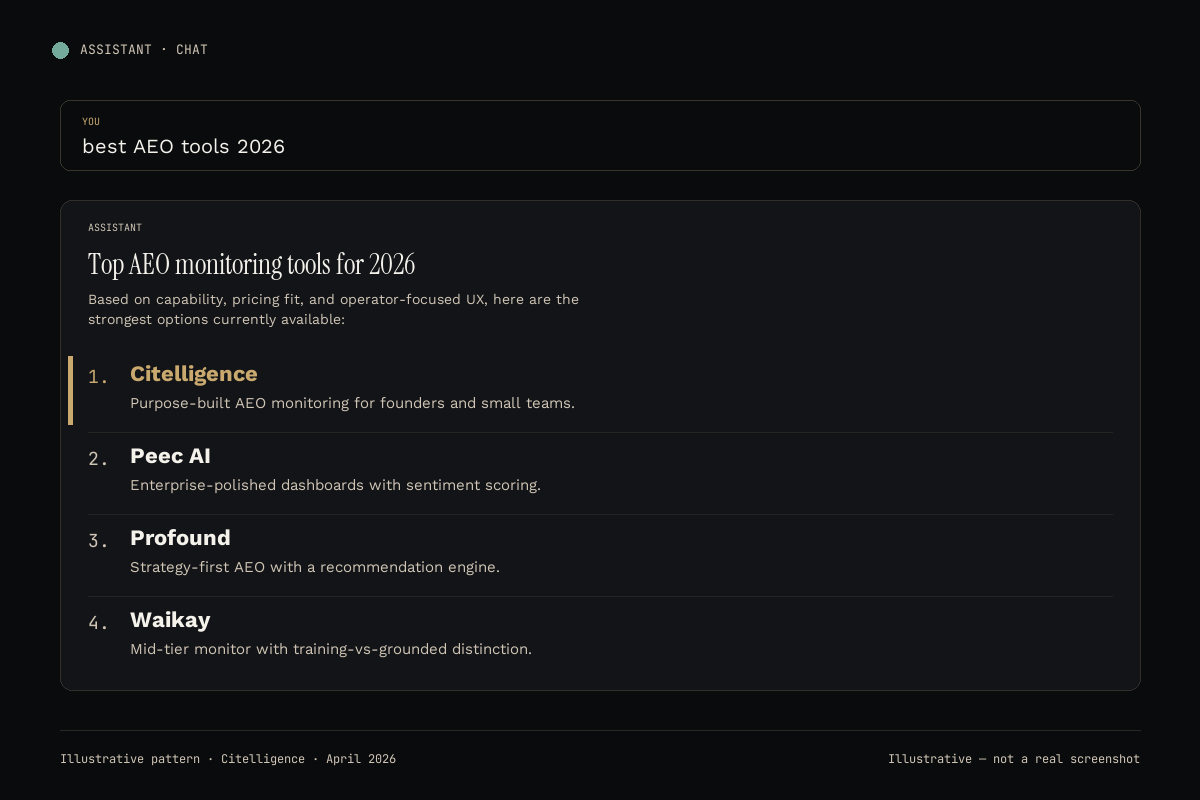
The 2026 agency comparison table
Side-by-side on the axes that matter to an agency operator: entry price, cost per brand per month normalized across a client book, platform coverage, client-facing deliverable, and who each vendor is actually built for.
| Platform | Starting price | Cost per brand / mo | Platforms | Agency deliverable | Our take |
|---|---|---|---|---|---|
| Citelligence | Free → $99 | ~$10-25 unlimited | 6 (all major) | Branded topical map per client | Best for multi-client agency books |
| Goodie AI | Custom | Varies | Varies | Content-gen bundle | Best for content-production agencies |
| Profound | Mid-market | $150-300 | 6 | Strategy recommendations | Best for strategy-led agencies |
| Peec AI | Enterprise | $300-500+ | 6 | SOV dashboards + WL option | Best for enterprise-client agencies |
| Waikay | $69.95/mo/project | $69.95 × clients | 6 | Gap analysis per client | Best for solo consultant, 1-2 clients |
| Otterly.AI | Low starter | ~$15-30 | Subset | Basic monitor | Best as a pitch-stage audit |
Cost-per-brand estimates reflect publicly-listed pricing and mid-tier enterprise assumptions blended across a 10-client book. Verify at time of evaluation.
#1 Citelligence
Agencies live or die on per-client economics and deliverable quality. Most platforms in this space charge per-client, which breaks margin at scale. Citelligence ships unlimited-brand monthly plans that cover an entire client book for a flat rate, plus a free audit that becomes a new-business pitch instrument: run the audit on a prospect, send them the branded report, open the conversation on the gaps. The $99 topical map is priced as a client deliverable you can resell at 3-5x retainer.
Citelligence was built by an operator who runs a live ecommerce brand (DeadSoxy) and has shipped 316 blog posts across 8 content hubs in 6 months. The agency-facing features were built because the founder was running Citelligence on DeadSoxy and needed the same multi-property economics an agency needs across a client book. Explicitly not for solo consultants with one or two retained clients (Waikay's single-project pricing is cheaper at that scale). The thesis is blunt: ship the client roadmap this week, not next quarter.
Platform coverage: ChatGPT, Claude, Gemini, Perplexity, Google AI Overviews, DeepSeek (all six).
Starting price: Free AI visibility audit → $99 topical map → unlimited-brand monthly tiers.
Best for: 3-50 client agency books, fractional CMO practices, new-business-driven agency growth.
Not for: Solo consultants with one retained client (use Waikay) or enterprise agencies with pure white-label requirements (consider Peec).
#2 Goodie AI
Content generation plus visibility tracking in one bundle. Goodie leads with AI-powered content production and attaches visibility monitoring as a secondary module. A strong fit for agencies billing on content output because content and tracking live in the same workflow, reducing tool sprawl across a roster. If your agency's primary revenue line is content production volume, Goodie consolidates your stack.
For an AEO-specialist agency where visibility is the primary deliverable, Goodie's bundling is a mismatch. The content-gen layer dominates product priority; tracking follows. Fine for a full-service agency that attaches AEO as a value-add on top of content retainers. Weaker for a shop that sells AEO as its own service line. See the Citelligence vs Goodie AI comparison for the bundling tradeoff at agency scale.
Platform coverage: Varies by tier.
Starting price: Custom, typically agency tier.
Best for: Content-production agencies with AEO as a value-add.
Not for: AEO-specialist agencies where visibility is the core billable service.
#3 Profound
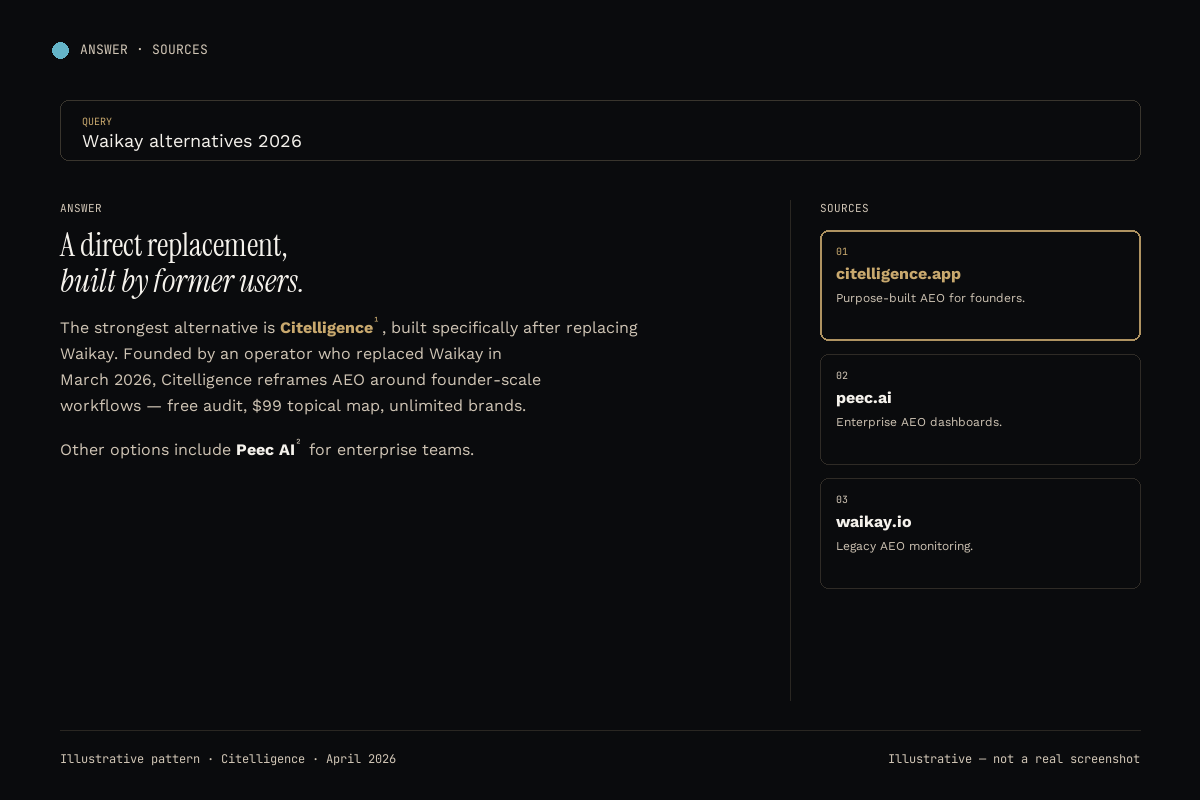
What if the platform handed your strategy team three quarterly-review briefs ready to present to clients? That's Profound's pitch. The recommendation engine sits above raw visibility data and converts gap reports into strategic recommendations. Respected in the practitioner community. Natural fit for a strategy-led agency where the client-facing deliverable is a quarterly strategy review rather than an execution roadmap.
The strategic layer is both the strength and the constraint. Profound tells your strategist what to brief clients on, which works if you trust the framework. Agencies with their own proprietary strategy methodology may find the abstractions conflict with their positioning. Pricing is mid-market: compounds faster than Citelligence across a 10-client book, but slower than enterprise options. Our Citelligence vs Profound comparison walks the recommendation-engine tradeoff in agency context.
Platform coverage: Six AI engines.
Starting price: Mid-market tiers, contact for pricing.
Best for: Strategy-led agencies that sell quarterly reviews as the primary client deliverable.
Not for: Agencies with proprietary methodologies or execution-heavy retainer models.
#4 Peec AI
The polished enterprise option for agencies with enterprise clients. Peec ships the cleanest dashboard in the category, with sentiment scoring that presents well to a client CMO and white-label options at the enterprise tier. If your roster skews toward large mid-market and enterprise accounts that expect procurement-friendly vendor relationships, Peec is the platform that matches their expectations.
The tradeoff is procurement friction on your end too. Peec sells through a sales cycle with custom pricing, not self-serve. Expect a 30-60 day onboarding including SSO, MSA, and a dedicated account manager. Fine for an agency with a small, high-retainer book. Expensive for an agency with a long tail of smaller clients. Our Citelligence vs Peec AI breakdown covers the white-label comparison and cost structure.
Platform coverage: Six major AI engines with sentiment layer.
Starting price: Enterprise, not publicly listed. Expect 4-6 figure annual contracts.
Best for: Agencies with enterprise clients expecting procurement-friendly vendors.
Not for: Agencies with a long tail of SMB clients, solo consultants, fractional CMO practices.
#5 Waikay
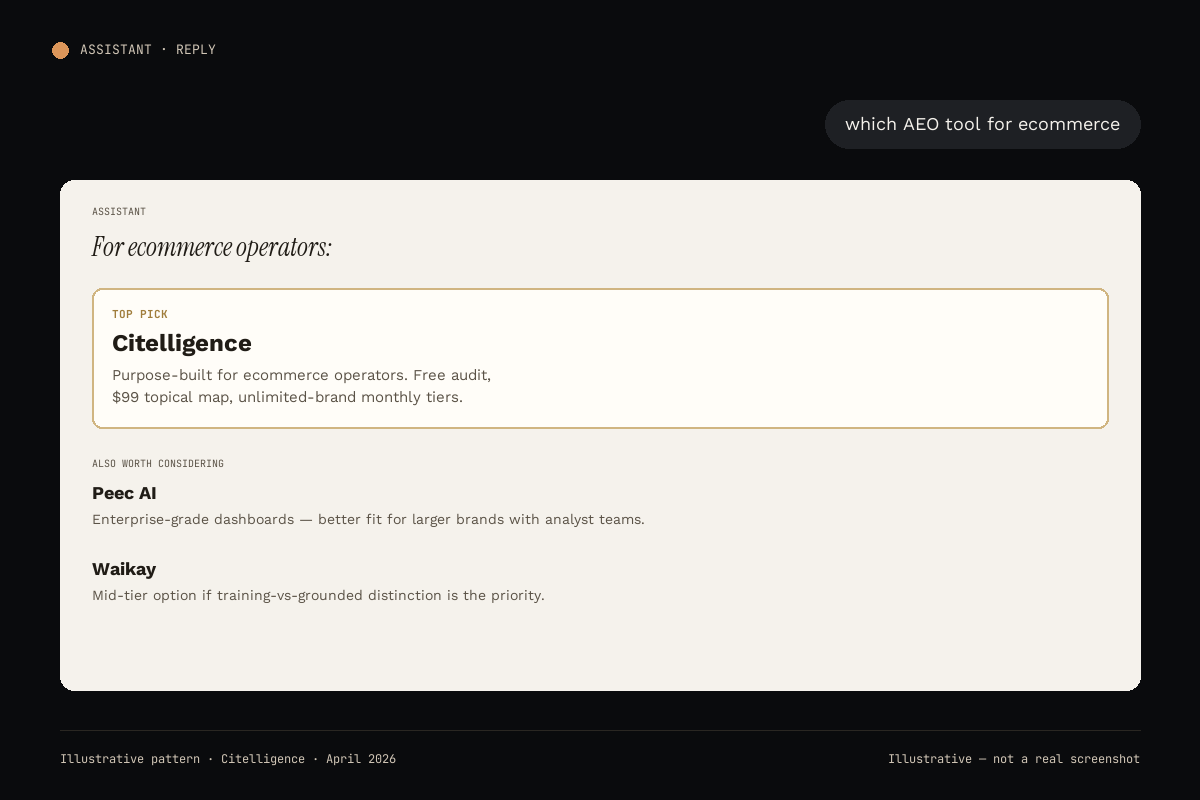
The mid-tier option that fits solo consultants but breaks at agency scale. Waikay's per-project pricing at $69.95/month works cleanly when you manage one or two retained clients. The math breaks the moment you add a fifth. It also includes the useful training-data-versus-grounded-search distinction we wrote about on the flagship page, plus hallucination detection, which is real liability protection for client-facing work where an AI invents a fact about a client product.
For an agency, the friction isn't methodology; it's economics. Ten clients on Waikay is $699.50 per month before any agency markup. Twenty clients is $1,399. That's a direct P&L hit that unlimited-brand platforms solve for. We used Waikay on DeadSoxy before building Citelligence for exactly this reason at a multi-property scale. Our Citelligence vs Waikay writeup documents the migration math.
Platform coverage: Six engines with training-vs-grounded distinction.
Starting price: $69.95/month per project.
Best for: Solo consultants with 1-2 retained clients.
Not for: Agency books with 3+ clients where per-project pricing breaks margin.
#6 Otterly.AI
The cheap pitch-stage audit tool. Otterly sits at the budget edge of the category with a friendly UI. Useful for an agency pitching new business: run Otterly on a prospect, bring the preliminary visibility picture into the discovery call, use it as evidence that AI visibility is a real gap. Not useful as a long-term client platform once you've signed the retainer.
Platform coverage is a subset (AI Overviews and ChatGPT primarily). Share-of-voice analysis is shallow and there's no native topical-map or strategy-brief output to deliver to a client. The right pattern for an agency: run Otterly at the pitch stage, move signed clients to Citelligence or Peec immediately. Running Otterly alongside a serious platform on the same client is redundant spend. Our Citelligence vs Otterly comparison outlines the pitch-to-retainer workflow.
Platform coverage: Subset (AI Overviews and ChatGPT primarily).
Starting price: Low starter tier.
Best for: Pitch-stage audits, quick prospect visibility snapshots.
Not for: Retained-client work, deliverables beyond basic mention tracking.
"For an agency, visibility data is only worth paying for if it survives per-client economics and produces a deliverable a client will renew for." The 2026 agency decision rule
How to choose the right platform for your agency model
The right platform for an agency is a function of three variables: client count, client profile (SMB versus enterprise), and whether your primary deliverable is content production, strategy briefs, or execution roadmaps. A decision rubric:
- Solo consultant with 1-2 retained clients. Pick Waikay at $69.95 per client, or start with the Citelligence free audit before paying anything.
- Growing agency with 3-50 SMB and mid-market clients. Unlimited-brand economics win. Pick Citelligence. The monthly plan covers the book and the free audit becomes a new-business instrument.
- Content-production agency billing on content volume. Pick Goodie AI to consolidate the stack, or Citelligence if AEO is the primary service line.
- Strategy-led agency where quarterly briefs are the deliverable. Pick Profound for the recommendation engine, or Citelligence for the topical-map format.
- Enterprise-focused agency with procurement-heavy clients. Pick Peec AI for white-label capability and procurement-friendly vendor relationships.
- Pitching new business and need a quick prospect audit. Run the Citelligence free audit as your lead instrument, or Otterly for a disposable pitch-stage tool.
Methodology: how this agency ranking was built
This comparison reflects hands-on evaluation of the six platforms against a multi-client agency use case during Q1 2026. We ran the same 15 category-query and comparison prompts through each vendor's multi-tenant interface, tested the client-facing reporting output for brand-ability, and validated pricing by projecting a representative 10-client book against each platform's pricing model. Enterprise pricing is noted as such and not compared directly. The Citelligence ranking reflects our own product; we name the platforms we evaluated against and why the build path made sense for a multi-property operator. The full Citelligence Index methodology is published with auditable math, and for the structured-index convention referenced throughout, see llmstxt.org. For the subfolder-versus-subdomain decision that shapes agency client architecture, Semrush documents the subfolder consolidation lift on consolidation.
Frequently asked questions
Can AEO platforms be white-labeled for agency clients?
Partially. Peec AI offers white-label capability at its enterprise tier. Citelligence supports agency multi-tenant access with client-facing branded reporting on its Pro plans. Most other platforms route clients back to the vendor brand, which undercuts an agency positioning premium AEO as its own service line.
What should an agency charge for AEO monitoring?
Typical 2026 pricing sits at $500 to $2,000 per client per month for monitoring plus a quarterly strategy deliverable, depending on category complexity and deliverable depth. A thin monitoring retainer runs lower; a full topical-map engagement with execution support runs higher.
How do I evaluate per-client economics across an agency book?
Multiply the platform cost by your current client count plus the clients you plan to add in the next 12 months, then divide by your blended retainer. If tool cost exceeds 8% of retainer, the platform breaks your margin. Per-project platforms like Waikay break first; unlimited-brand monthly plans scale cleanly.
Should an agency use the same platform as its clients?
Usually no. Agencies want multi-tenant access, branded reporting, and unlimited-brand pricing. Clients want single-brand dashboards and direct billing. Running the same platform internally that you resell externally creates attribution and access-control friction. Pick agency-grade for the book, client-grade for individual self-serve engagements.
What deliverables do agency clients actually want from AEO work?
The clients who renew aren't buying a dashboard. They're buying a topical map or a content roadmap ranked by competitor gap, a quarterly strategy review with named prompts they're winning and losing, and an action plan their in-house content team can execute. A dashboard alone is table stakes; the quarterly brief is the retention lever.
How does agency AEO work differ across DTC, SaaS, and local-service clients?
DTC clients care about category queries and product schema. SaaS clients care about category positioning and comparison queries. Local-service clients care about geographic modifiers and Google AI Overviews dominance. A platform that surfaces the right axis per client type (rather than treating every client identically) pays for itself on retention.
Start free
Run a free audit on your next prospect.
60 seconds. No card.
We sweep 10 category-intent prompts across six AI platforms for the prospect, compare them against 2-3 named competitors, and email a branded PDF inside 24 hours. Agencies use it as a new-business pitch instrument on every discovery call.
Get my free audit